


What Is a Cooling Tower?
A cooling tower is a type of direct-contact heat exchanger designed to lower the temperature of water by bringing it into contact with ambient air. The primary cooling mechanism is evaporative heat transfer: as a portion of the water evaporates, it removes heat from the remaining liquid, reducing its temperature.
In a typical system, water that has absorbed heat from an industrial process or an HVAC condenser is pumped to the cooling tower. This warm water is distributed through spray nozzles onto a structured packing material known as fill. The fill increases the contact surface area and residence time of the water, improving the efficiency of heat and mass transfer.
Simultaneously, air is drawn through the tower—usually by an electric motor–driven fan. As the air moves past the thin film or droplets of water on the fill, evaporation occurs. This phase change removes significant thermal energy due to the high latent heat of vaporization of water, thereby cooling the remaining water.
The cooled water collects at the basin at the bottom of the tower and is then pumped back to the condenser or industrial equipment to absorb heat once again. This establishes a continuous loop of heat removal.
For additional foundational information, contact the ICT Sales Representative in your area.
Types of Cooling Towers
Cooling towers are designed in several configurations, each suited for specific thermal, spatial, and operational requirements. Selecting the appropriate tower type requires understanding the airflow pattern, water distribution method, fan arrangement, and method of construction. The following sections outline the major cooling tower classifications along with their practical advantages and limitations.
Crossflow Cooling Towers
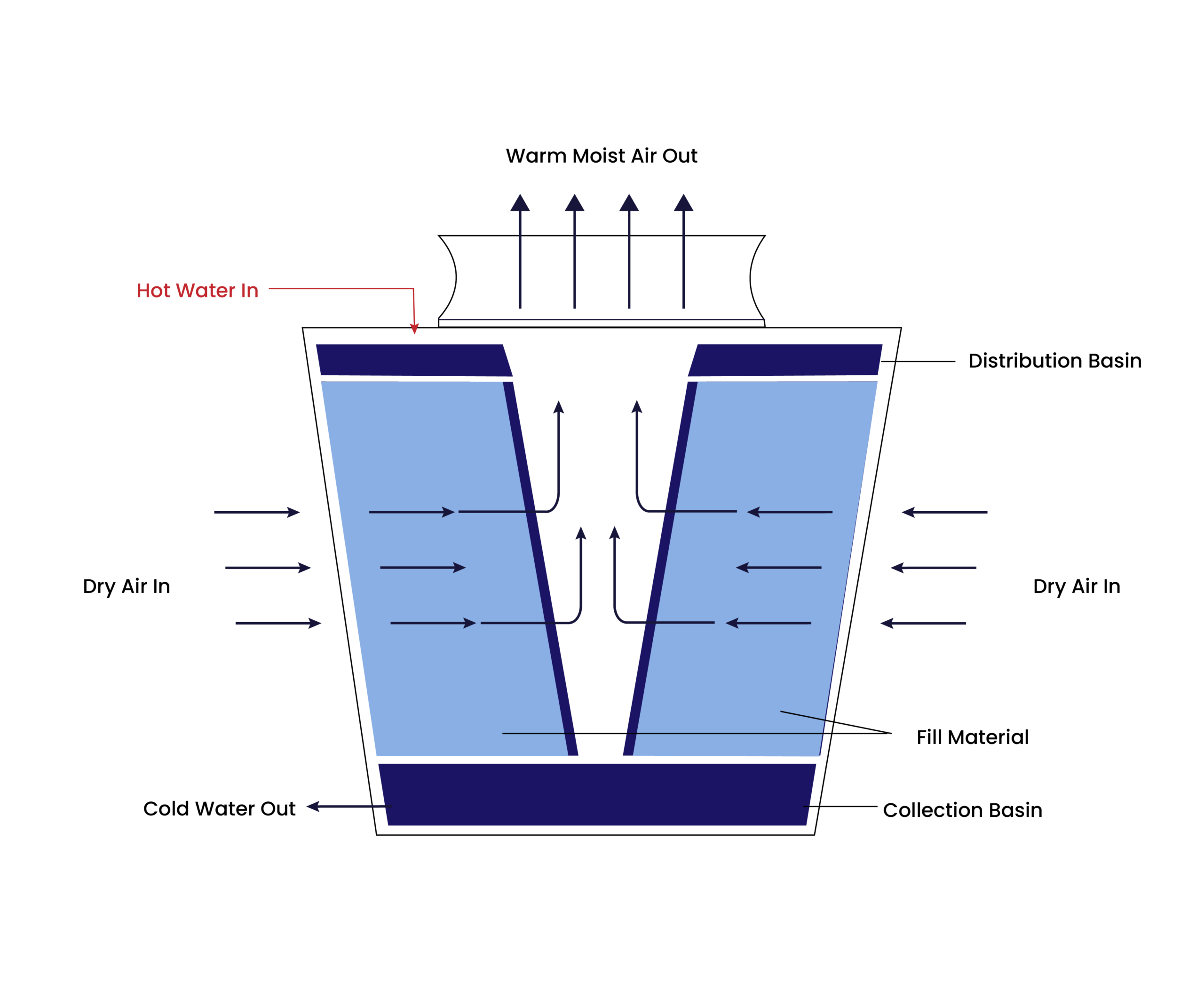
In a crossflow cooling tower, water flows downward through the fill media while air moves horizontally across it. This perpendicular flow path allows the air to avoid passing through the water distribution system. As a result, crossflow towers commonly use gravity‑fed hot water distribution basins located above the fill.
These open, non‑pressurized basins simplify maintenance and operation, and they are standard across virtually all crossflow designs. However, the layout typically requires more physical space compared to counterflow configurations.
Counterflow Cooling Towers
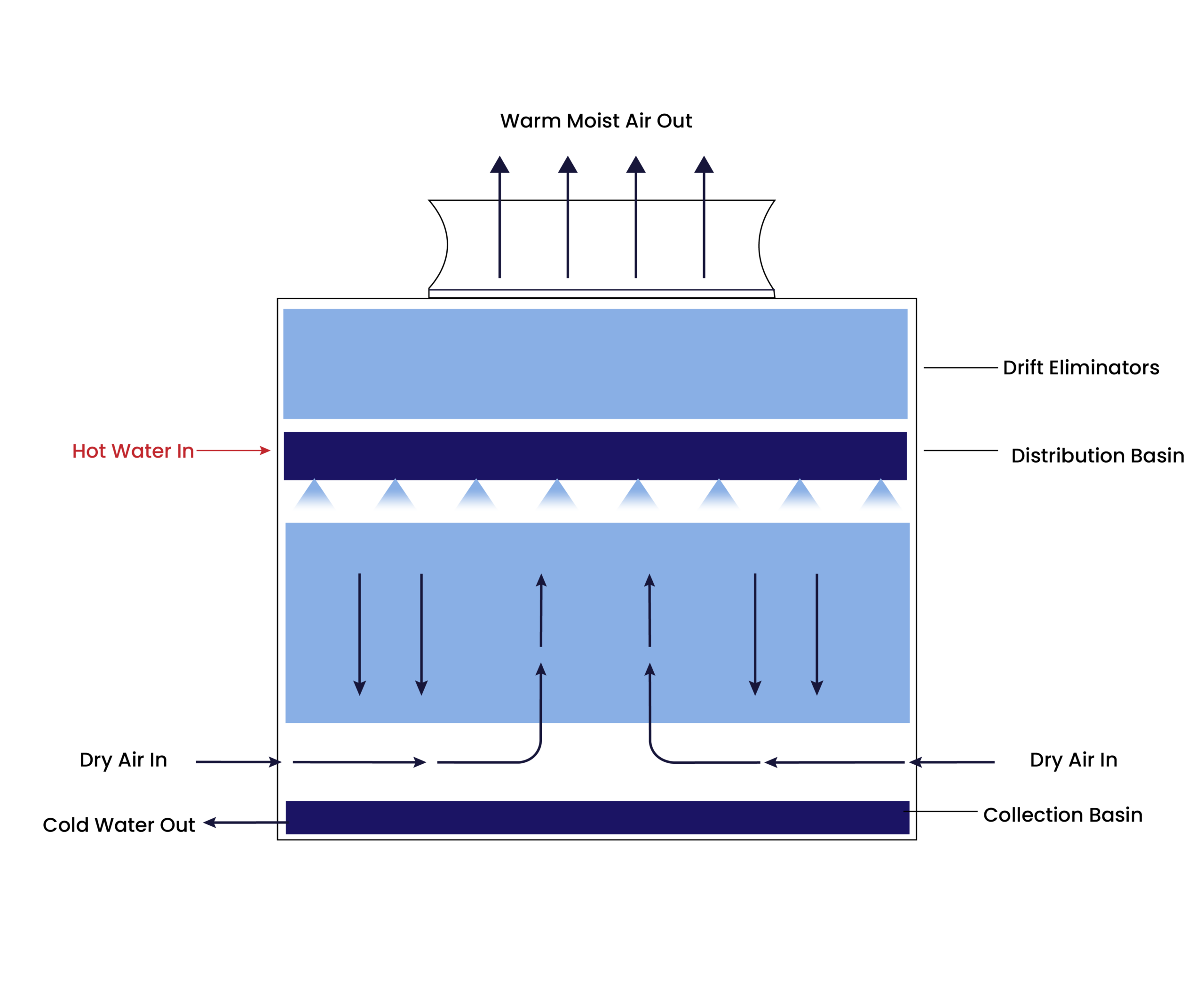
Counterflow cooling towers direct air upward through the fill while water flows downward in the opposite direction. Because the airflow is vertical, gravity‑flow distribution basins cannot be used. Instead, counterflow towers employ pressurized spray systems that distribute water over the fill.
To allow unobstructed airflow, the spray piping and nozzles must be spaced widely enough to avoid restricting the upward air movement. Counterflow towers generally offer a more compact footprint and are often more thermally efficient, but their pressurized distribution systems can be more complex to maintain.
Induced Draft vs. Forced Draft Cooling Towers
Cooling towers can also be distinguished by how air is moved through the system:
- Induced Draft Towers
These towers use fans mounted at the top (discharge) to pull air through the fill media. The induced airflow creates a uniform air velocity and typically improves thermal performance. - Forced Draft Towers
In this configuration, fans or blowers are located at the air inlet, pushing air into the tower. Forced draft towers may offer lower initial cost but are more susceptible to recirculation of warm, moist discharge air, especially under unfavorable wind conditions.
Factory‑Assembled vs. Field‑Erected Cooling Towers
Cooling towers are also manufactured and delivered using different construction approaches:
Factory‑Assembled Towers
Factory‑assembled towers—sometimes called “packaged towers”—are built at the manufacturing facility and shipped in the largest sections that can be transported. Smaller units may arrive nearly complete, while larger multi‑cell towers are shipped as pre‑built modules for final assembly on site.
Factory-assembled towers are available in both crossflow and counterflow configurations and may be induced or forced draft depending on application needs. There are many companies that produce factory‑assembled cooling towers.
Field‑Erected Towers
Field‑erected towers are primarily constructed at the installation site. Components are prefabricated, labeled, and delivered for assembly, often with manufacturer‑provided labor and supervision.
These towers are typically used for large‑scale applications such as power generation and heavy industrial cooling. Field‑erected systems, like the ICT CF9846 counterflow tower or XF78 crossflow tower, can be extensively customized for specific performance, structural, or environmental requirements, including drift control and plume abatement.
Frequently Asked Questions (FAQs)
Find answers to the most common questions about our Cooling Towers. If you can’t find what you’re looking for here, please contact us.
A cooling tower uses water-based evaporative cooling, where warm process water is sprayed over fill material and cooled as a portion evaporates, allowing temperatures to approach the ambient wet bulb temperature. This makes cooling towers highly effective for large heat rejection loads, but they require significant water consumption, continuous water treatment, and more maintenance due to scaling, corrosion, and biological control needs.
In contrast, an Air Cooled Heat Exchanger (ACHE) uses ambient air as the sole cooling medium. Hot fluids pass through finned tubes while fans force air across them, enabling dry cooling without evaporation. ACHEs consume no water, have lower maintenance requirements, and are well suited for regions with limited water availability or facilities seeking to avoid the complexity of water treatment systems. However, their cooling performance is constrained by dry bulb temperature, meaning they cannot achieve the lower outlet temperatures that evaporative cooling systems can.
Overall, cooling towers offer high cooling efficiency for demanding industrial applications, whereas ACHEs provide simpler, water free operation at the cost of higher temperature limitations.
In sub‑freezing environments, ACHEs are generally the better choice because they use only ambient air for cooling and do not rely on circulating water, which eliminates the risk of ice formation—a major operational challenge for cooling towers in cold climates. Cooling towers require continuous water flow for evaporative cooling, making them vulnerable to freezing on fill, basins, and exposed piping.
However, ACHEs also have limitations. Their performance is restricted by the dry‑bulb temperature, which means they may not meet the cooling demands of facilities with large heat‑rejection loads, especially in heavy industrial applications. They also require larger surface areas and higher fan power to achieve the same cooling duty, increasing both space and energy requirements.
Despite these constraints, ACHEs remain the more reliable and freeze‑resistant option for cold climates. That said, cooling towers can still be successfully operated in sub‑freezing conditions when properly designed and managed. ICT (International Cooling Tower Inc.) has over 60 years of experience designing, maintaining, and operating cooling towers in sub‑freezing environments, and can help determine the best solution for your specific cooling requirements. Contact the ICT Sales Representative in your area to learn how this expertise can support your facility’s needs.
In most modern cooling tower installations, full shutdown is not required for routine maintenance activities. This is because cooling towers are commonly built as multi‑cell systems, where each cell operates as an independent heat‑rejection unit within the larger tower structure. As a result, one cell can be taken offline for maintenance while the adjacent cells remain in full operation, allowing the facility to maintain cooling capacity and avoid major process interruptions.
Many types of corrective work—such as mechanical repairs, component replacement, drift eliminator or fill section upgrades, and fan or motor servicing—can be performed safely and effectively on an isolated cell while the rest of the tower remains online. In some cases, significant subsystem replacements can be completed without taking the entire tower out of service, provided that the maintenance plan accounts for load distribution, hydraulic balance, and safe isolation procedures.
However, the feasibility of online maintenance depends on several factors, including total cooling load, redundancy in system design, weather conditions, and operational constraints of the facility. Facilities operating at or near maximum capacity may have limited flexibility to take individual cells offline without affecting process temperatures or system performance.
ICT (International Cooling Tower Inc.) has extensive experience performing both online and offline maintenance activities. ICT can support your team in assessing what types of work can be executed while maintaining system operation and determining whether the cooling load and tower configuration allow for safe isolation of individual cells. To discuss maintenance strategies or evaluate your site‑specific requirements, contact the ICT Sales Representative in your area—we’re here to help you identify the safest and most efficient approach for your cooling needs.
Contact ICT
Contact us.

Find an ICT Rep
For more information, contact a representative near you.